
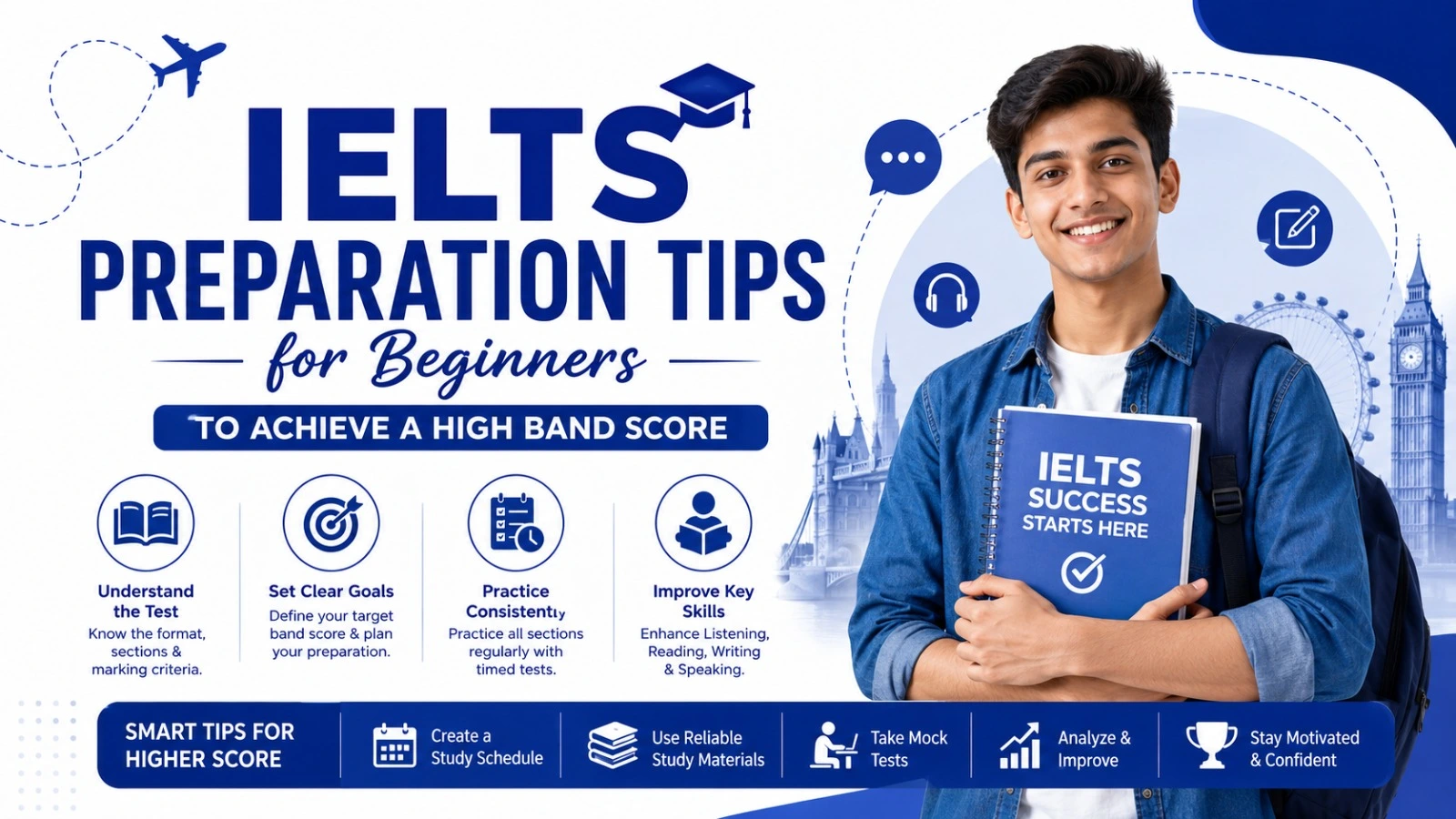
For students and professionals planning to study, work, or migrate abroad, the International English Language Testing System (IELTS) is one of the most widely accepted English language proficiency examinations. A strong IELTS band score can improve your chances of gaining admission to international universities, securing global career opportunities, and meeting immigration requirements in various countries.
However, many beginners start their IELTS preparation without a clear strategy. They often focus only on practicing questions while overlooking important aspects such as understanding the exam format, improving language skills, managing time effectively, and developing confidence in all four test modules. As a result, they may spend weeks preparing without seeing significant improvements in their performance.
The good news is that achieving a high score does not always require studying for long hours. What matters most is following the right approach from the beginning. Understanding how to prepare for IELTS, creating a realistic study plan, and practicing consistently can help beginners make steady progress and avoid common mistakes that often affect exam results.
This guide shares practical IELTS preparation tips for beginners, covering everything from understanding the test structure and building essential English skills to using mock tests effectively and improving performance in each module. Whether you are aiming for academic admission, professional opportunities, or migration goals, these strategies can help make your IELTS exam preparation more focused, efficient, and result-oriented.
Understanding the IELTS Exam Before You Start Preparing
Before beginning your IELTS preparation, it is important to understand how the exam is structured and how candidates are assessed. Many beginners jump directly into practice tests without learning the exam format, which often leads to confusion, poor time management, and avoidable mistakes during the actual test.
The IELTS exam is designed to evaluate a candidate’s English language proficiency across four key skills:
- Listening
- Reading
- Writing
- Speaking
Each section measures a different aspect of communication and contributes to your overall IELTS band score. Understanding the purpose and requirements of each module allows you to create a more effective study plan and focus on areas that need improvement.
There are two versions of the IELTS exam:
| IELTS Type | Purpose |
| IELTS Academic | For higher education and professional registration abroad |
| IELTS General Training | For migration, work opportunities, and secondary education purposes |
Choosing the correct test type is essential because the Reading and Writing sections differ between Academic and General Training IELTS.
Another important aspect of IELTS exam preparation is understanding how band scores are calculated. Each module is scored on a scale of 0 to 9, and the average of these scores determines your overall band score. Universities, employers, and immigration authorities often set minimum score requirements based on their criteria.
Some key facts every beginner should know include:
- IELTS assesses practical communication skills rather than memorized knowledge.
- All four modules contribute to your final result.
- Time management plays a major role in exam performance.
- Consistent practice is more effective than last-minute preparation.
- Understanding assessment criteria can help improve your scores.
Candidates who familiarize themselves with the exam structure early often find it easier to plan their studies and track their progress. According to the official IELTS preparation resources, understanding the test format and assessment criteria is one of the first steps toward achieving better results.
By taking the time to understand the IELTS exam before starting your preparation journey, you can approach each section with greater confidence and build a stronger foundation for achieving your target IELTS band score.
Setting a Realistic IELTS Preparation Plan
A well-structured study plan is one of the most important factors in successful IELTS exam preparation. Many beginners begin studying without a clear schedule, often spending too much time on certain sections while neglecting others. This can lead to inconsistent progress and make it more difficult to achieve the desired IELTS band score.
Before creating a preparation plan, identify your target band score and understand the requirements of the university, employer, or immigration program you are applying to. Having a clear goal helps you determine how much preparation is needed and allows you to allocate your study time more effectively.
An effective IELTS study plan should focus on:
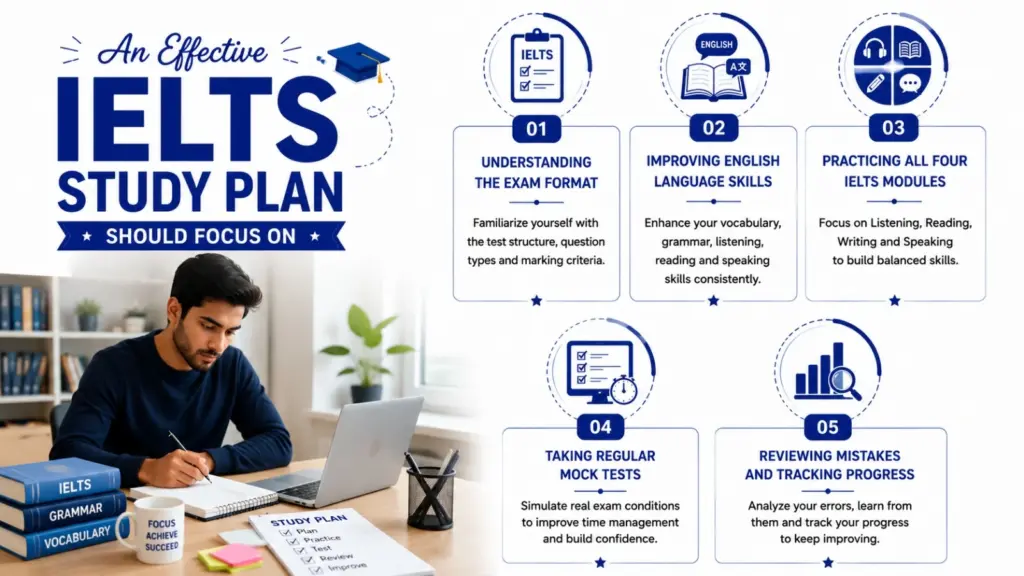
- Understanding the exam format
- Improving English language skills
- Practicing all four IELTS modules
- Taking regular mock tests
- Reviewing mistakes and tracking progress
Consistency is often more effective than studying for long hours occasionally. Even one to two hours of focused daily practice can help you build skills gradually and improve your confidence over time.
Sample IELTS Study Plan for Beginners
| Preparation Stage | Focus Area | Recommended Duration |
| Week 1–2 | Understanding IELTS Format | 1–2 Hours Daily |
| Week 3–4 | Grammar, Vocabulary & Skill Building | 2 Hours Daily |
| Week 5–6 | Module-Based Practice | 2–3 Hours Daily |
| Week 7–8 | Mock Tests & Performance Review | 2–3 Hours Daily |
To maximize your progress, divide your weekly schedule across all four modules. This helps maintain balanced preparation and ensures that weaker areas receive enough attention.
For example:
- Monday: Listening and Reading practice
- Tuesday: Writing practice
- Wednesday: Speaking practice
- Thursday: Listening and Reading revision
- Friday: Writing improvement exercises
- Saturday: Full-length mock test
- Sunday: Performance review and error analysis
Beginners can strengthen their preparation strategy by exploring official IELTS preparation resources, which provide sample questions, study materials, and guidance directly aligned with the exam format. These resources can help candidates understand expectations and build a more focused approach to IELTS preparation.
By setting realistic goals, following a structured schedule, and evaluating your performance regularly, you can make your preparation more organized and significantly increase your chances of achieving a high IELTS band score.
Building Strong English Skills for Better IELTS Performance
While understanding the exam format is important, achieving a high IELTS band score ultimately depends on your English language proficiency. Many beginners focus heavily on practice tests but overlook the importance of strengthening their core language skills. A strong foundation in English can make every section of the exam easier and improve overall performance.
Effective IELTS preparation should include continuous improvement in vocabulary, grammar, reading comprehension, listening ability, and spoken communication. These skills not only help during the exam but also prepare candidates for academic and professional environments where English is the primary language.
Some practical ways to improve your English skills include:
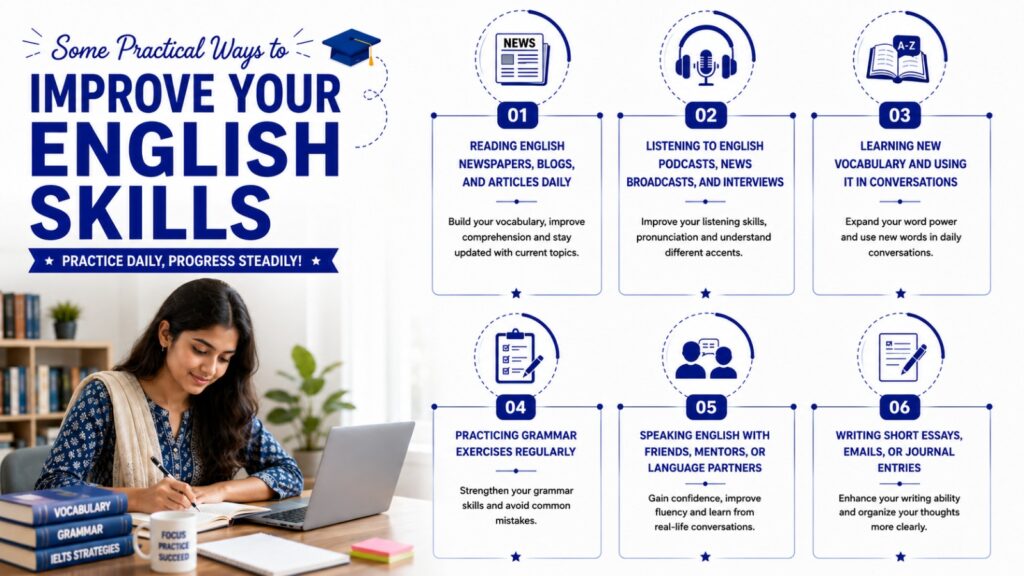
- Reading English newspapers, blogs, and articles daily
- Listening to English podcasts, news broadcasts, and interviews
- Learning new vocabulary and using it in conversations
- Practicing grammar exercises regularly
- Speaking English with friends, mentors, or language partners
- Writing short essays, emails, or journal entries
Developing these habits can help you become more comfortable with the language and reduce common mistakes that affect IELTS scores.
One of the most effective strategies for beginners is to create a daily language-learning routine. Even 30 to 60 minutes of focused practice can lead to noticeable improvements over time.
Here are some areas that deserve special attention:
- Vocabulary: Learn topic-specific words commonly used in IELTS Reading, Writing, and Speaking tasks.
- Grammar: Focus on sentence structure, tenses, punctuation, and subject-verb agreement.
- Reading Skills: Practice understanding main ideas, identifying details, and interpreting information quickly.
- Listening Skills: Expose yourself to different English accents to improve comprehension.
- Speaking Confidence: Practice expressing your thoughts clearly and naturally without memorizing answers.
Many students preparing for international education also benefit from environments that encourage practical communication and continuous learning. An industry-academia learning approach can help learners develop both language and professional skills that support long-term success.
Building strong English skills takes time, but consistent effort can significantly improve your confidence and make your IELTS exam preparation more effective. The stronger your language foundation, the easier it becomes to perform well across all four IELTS modules.
Module-Wise IELTS Preparation Tips for Beginners
Each section of the IELTS exam evaluates a different language skill, which means your preparation strategy should vary for every module. While general English proficiency is important, understanding how to approach each section can significantly improve your performance and help you achieve a higher IELTS band score.
Smart Strategies for All Four IELTS Modules
Listening
The Listening module tests your ability to understand conversations, discussions, and academic talks in different English accents.
To improve your Listening score:
- Listen to English podcasts and news broadcasts regularly.
- Practice note-taking while listening.
- Focus on identifying keywords and important details.
- Familiarize yourself with British, Australian, Canadian, and American accents.
- Complete timed listening exercises to improve concentration.
Reading
The Reading section measures your ability to understand and analyze written information quickly.
Helpful Reading strategies include:
- Practice skimming to understand the main idea of a passage.
- Use scanning techniques to locate specific information.
- Improve vocabulary through daily reading habits.
- Learn to manage time effectively across all questions.
- Avoid spending too much time on difficult passages.
Writing
Many candidates find Writing to be the most challenging part of IELTS exam preparation because it requires strong grammar, vocabulary, and organization skills.
To improve your Writing performance:
- Learn the structure of Task 1 and Task 2 responses.
- Focus on coherence and logical flow.
- Use a variety of vocabulary naturally.
- Practice writing essays under timed conditions.
- Review feedback and correct recurring mistakes.
Speaking
The Speaking module assesses fluency, pronunciation, vocabulary, and communication skills.
To improve your Speaking score:
- Speak English daily whenever possible.
- Practice answering common IELTS Speaking questions.
- Record your responses and evaluate your fluency.
- Avoid memorized answers.
- Focus on expressing ideas clearly and confidently.
IELTS Modules and Preparation Focus
| IELTS Module | Key Skill Required | Preparation Focus |
| Listening | Information Recognition | Audio Practice & Note-Taking |
| Reading | Comprehension | Skimming & Scanning Techniques |
| Writing | Structured Communication | Essay Writing & Task Practice |
| Speaking | Fluency & Confidence | Regular Speaking Exercises |
Many beginners looking for additional guidance often benefit from reviewing an IELTS preparation guide for beginners, which provides practical strategies, study recommendations, and insights into the exam structure.
Success in IELTS comes from balanced preparation across all four modules. Rather than focusing only on your strongest areas, dedicate time to improving weaker sections as well. This approach can help you achieve a stronger overall IELTS band score and perform more confidently on exam day.
Using Practice Tests to Improve Your IELTS Band Score
Practice tests are one of the most effective tools for improving your IELTS performance. While learning concepts and strengthening language skills are essential, regular practice helps you understand how the exam works under real test conditions. For many beginners, mock tests bridge the gap between preparation and actual exam performance.
One of the biggest advantages of practice tests is that they help you become familiar with the exam format and time limits. Many candidates know the answers but struggle to complete sections within the allotted time. Regular testing helps develop the speed and accuracy needed to perform well on exam day.
Some key benefits of taking practice tests include:
- Understanding the actual IELTS exam structure
- Improving time-management skills
- Identifying strengths and weaknesses
- Building confidence before the exam
- Reducing test-day anxiety
- Tracking progress over time
Practice tests also provide valuable insights into your performance. Instead of simply checking your score, take time to analyze your mistakes and understand why they occurred. This allows you to focus on areas that need improvement and avoid repeating the same errors.
To get the most value from mock tests:
- Take tests in a quiet environment.
- Follow official exam timing strictly.
- Avoid using dictionaries or external help.
- Review every incorrect answer.
- Maintain a record of recurring mistakes.
- Focus on gradual improvement rather than immediate perfection.
Many beginners make the mistake of taking multiple practice tests without reviewing their results. However, learning from your mistakes is just as important as completing the test itself.
Students looking for additional preparation support can explore the IELTS preparation guide for beginners to understand effective study techniques and preparation strategies recommended for first-time test takers.
The more familiar you become with the exam environment, the more confident you will feel on test day. Consistent practice combined with proper review can significantly improve your overall IELTS band score and help you approach the exam with greater confidence.
Common Mistakes That Prevent a High IELTS Band Score
Many candidates spend weeks preparing for IELTS but fail to achieve their target score because of avoidable mistakes. While improving English skills is important, understanding what not to do during your preparation can be equally valuable. Identifying these common errors early can make your IELTS preparation more efficient and help improve your overall performance.
One of the most common mistakes is focusing only on stronger modules while ignoring weaker areas. For example, some students spend most of their time practicing reading and listening while neglecting Writing or Speaking. Since all four modules contribute to your overall IELTS band score, balanced preparation is essential.
Here are some mistakes beginners should avoid:
- Starting preparation without a study plan
- Ignoring the official IELTS assessment criteria
- Practicing inconsistently
- Memorizing Speaking answers
- Skipping mock tests
- Focusing only on grammar and vocabulary
- Neglecting time-management practice
- Failing to review mistakes after practice sessions
Another common issue is treating IELTS as a test of knowledge rather than communication skills. The exam evaluates how effectively you can understand, analyze, and communicate in English. Candidates who rely heavily on memorized responses often struggle in the Speaking and Writing sections because examiners can easily identify rehearsed answers.
Time management is another major challenge. Many test takers know the material but fail to complete sections within the allotted time. Regular practice under timed conditions can help build speed and confidence.
To avoid these challenges:
- Create a structured preparation schedule.
- Practice all four modules regularly.
- Review every mock test carefully.
- Focus on improving weak areas.
- Learn from feedback and recurring mistakes.
- Simulate real exam conditions during practice.
Students looking for additional strategies to improve their IELTS band score faster can benefit from expert recommendations and proven preparation techniques designed to maximize performance.
Avoiding these common mistakes can make a significant difference in your results. With consistent effort, smart preparation, and regular self-assessment, beginners can approach the IELTS exam with greater confidence and improve their chances of achieving a high band score.
How Expert Guidance Can Make IELTS Preparation Easier
Preparing for IELTS independently can work for some learners, but many beginners struggle to identify their weaknesses, follow a consistent study plan, and apply the right exam strategies. Without proper guidance, it is easy to spend time on ineffective study methods that may not contribute significantly to improving your IELTS band score.
Expert guidance helps simplify the preparation process by providing structure, accountability, and personalized support. Experienced trainers understand the IELTS assessment criteria and can help students focus on the areas that need the most improvement.
Some advantages of guided IELTS preparation include:
- Structured study plans and learning schedules
- Personalized feedback on Writing and Speaking tasks
- Regular mock tests and progress evaluations
- Effective strategies for all four IELTS modules
- Better time-management skills
- Consistent motivation and support
One of the most valuable aspects of professional guidance is personalized feedback. Many candidates repeatedly make the same mistakes in their Writing and Speaking tasks without realizing it. Trainers can identify these patterns, explain where marks are being lost, and suggest practical ways to improve performance.
Guided preparation also helps students stay disciplined throughout their learning journey. Instead of studying randomly, candidates can follow a structured roadmap designed to help them achieve their target score within a realistic timeframe.
In addition to exam preparation, learning environments that promote an industry-academia learning approach encourage continuous skill development and effective communication practices. These skills can be beneficial not only for IELTS success but also for future academic and professional opportunities.
Students who require personalized advice regarding IELTS preparation strategies, study plans, or future learning opportunities can contact our team for additional guidance and support.
While dedication and consistent practice remain essential, expert guidance can make the preparation process more focused, efficient, and less overwhelming. With the right support system in place, beginners can build confidence, improve their performance across all four modules, and move closer to achieving their desired IELTS band score.
Final Thoughts
Achieving a high IELTS band score is possible for beginners when preparation is approached with the right strategy. Rather than focusing solely on practice tests, candidates should take the time to understand the exam format, strengthen their English language skills, and develop a structured study plan that covers all four modules effectively.
Successful IELTS preparation requires consistency, patience, and continuous improvement. Regular practice, mock tests, vocabulary building, and time-management techniques can help learners identify their weaknesses and gradually improve their performance. Avoiding common mistakes and reviewing progress regularly can also make a significant difference in achieving the desired results.
Whether you are preparing for higher education, career opportunities, or migration goals, a focused preparation strategy can help you approach the exam with confidence. By applying the IELTS preparation tips for beginners discussed in this guide, you can improve your skills, enhance your confidence, and move closer to achieving your target IELTS band score.
Start Your IELTS Journey with Confidence
A strong IELTS score can open doors to global education opportunities, international careers, and new experiences abroad. However, achieving your target score requires more than determination-it requires the right preparation strategy, expert guidance, and consistent practice.
By following the IELTS preparation tips discussed in this guide, beginners can build a strong foundation, improve their English proficiency, and approach the exam with greater confidence. The sooner you start preparing with a structured plan, the better positioned you will be to achieve your desired results.
If you’re ready to take the next step, explore our IELTS preparation program and discover how expert training, personalized feedback, and comprehensive practice can help you work toward a high IELTS band score with confidence.
FAQs
1. How long does it take for beginners to prepare for IELTS?
The preparation time depends on your current English proficiency and target IELTS band score. Most beginners require between 6 and 12 weeks of consistent study to build their skills, practice all four modules, and become familiar with the exam format.
2. What is the fastest way to improve an IELTS band score?
The fastest way to improve your IELTS band score is to follow a structured study plan, practice regularly, take mock tests, and focus on your weaker areas. Consistent practice and targeted improvement often produce better results than studying for long hours without a strategy.
3. How can I prepare for IELTS at home?
You can prepare for IELTS at home by using official study materials, practicing sample tests, improving your vocabulary, reading English content daily, and developing your listening, writing, and speaking skills through regular practice.
4. How many hours should I study each day for IELTS preparation?
For most beginners, studying 1–2 hours daily is sufficient if the preparation is consistent and focused. Candidates aiming for a higher band score may benefit from increasing their study time while maintaining a balanced preparation schedule.
5. What is a good IELTS band score?
A good IELTS band score depends on your goals. Many universities accept scores between 6.0 and 7.5, while some immigration and professional programs may require higher scores. Always check the specific requirements of your chosen institution or organization.
6. Which IELTS module is the most difficult for beginners?
The difficulty level varies from person to person. However, many beginners find the Writing and Speaking modules challenging because they require strong grammar, vocabulary, organization, and communication skills.
7. Are mock tests important for IELTS exam preparation?
Yes, mock tests are an essential part of IELTS exam preparation. They help you understand the exam format, improve time management, identify weaknesses, and build confidence before the actual test.
8. Can I achieve a high IELTS band score without coaching?
Yes, many candidates achieve high IELTS scores through self-study. However, coaching can provide structured guidance, expert feedback, and personalized strategies that may help improve performance more efficiently.
9. How often should I practice IELTS Speaking?
It is recommended to practice IELTS Speaking daily or at least several times a week. Regular speaking practice helps improve fluency, pronunciation, confidence, and the ability to express ideas naturally during the exam.
10. What are the most common mistakes during IELTS preparation?
Common mistakes include studying without a plan, neglecting weaker modules, avoiding mock tests, memorizing Speaking answers, and failing to review mistakes. Avoiding these errors can significantly improve your overall IELTS performance.