
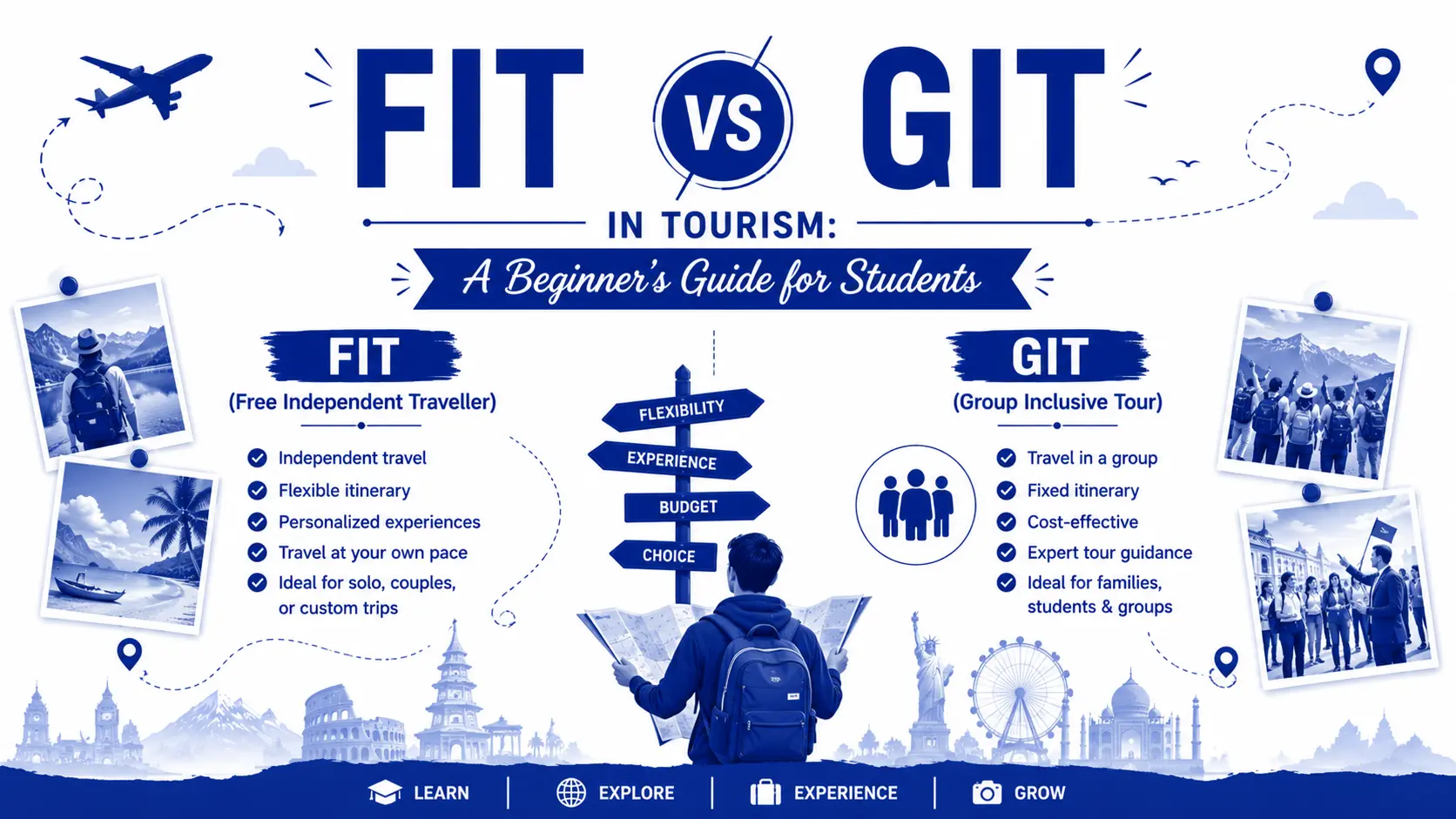
The tourism industry uses a variety of terms and concepts that help professionals plan, manage, and deliver travel experiences effectively. Among the most commonly used terms are FIT and GIT in Tourism, which represent two different approaches to organizing travel packages and customer experiences. Understanding these concepts is essential for tourism students because they form the foundation of travel operations, tour planning, and package management within the industry.
Travel agencies, tour operators, and tourism organizations regularly work with both FIT and GIT travelers depending on customer preferences, budgets, and travel requirements. While some travelers prefer personalized and flexible itineraries, others choose organized group tours that offer convenience and cost advantages. Understanding the differences between FIT and GIT tourism helps students gain valuable knowledge about how tourism businesses design and manage various types of tourism packages.
For learners preparing for tourism careers, internships, or industry interviews, knowledge of free independent traveler and group inclusive tour concepts is highly beneficial. These terms are frequently used in travel operations and tourism management, making them important topics for anyone seeking a deeper understanding of tourism industry practices. By learning how FIT and GIT travel models work, students can strengthen their industry knowledge and improve their readiness for future opportunities in the tourism sector.
What Does FIT Mean in Tourism?
FIT stands for Free Independent Traveler (sometimes referred to as Fully Independent Traveler), a travel category where individuals or small groups plan and travel independently rather than joining organized group tours. In the tourism industry, FIT travelers typically prefer customized itineraries, flexible schedules, and personalized travel experiences that align with their specific interests and preferences.
FIT travel packages are designed according to the traveler’s requirements and may include:
- Customized itineraries
- Personalized accommodation choices
- Flexible travel schedules
- Private transportation arrangements
- Tailored sightseeing experiences
- Individual travel support services
Unlike group tours, FIT travelers have greater control over their travel plans and can modify activities, destinations, and schedules based on their preferences. This flexibility makes FIT travel popular among solo travelers, couples, families, and business travelers who seek unique and personalized experiences.
Travel agencies and tour operators often create customized packages for FIT customers by coordinating flights, accommodations, transportation, and sightseeing activities according to individual needs. Since these packages require more planning and customization, they are generally more personalized than standard group tours.
According to insights on independent travel concepts, FIT travel focuses on providing travelers with flexibility, independence, and customized experiences, making it one of the most preferred travel models for individuals seeking greater control over their journeys.
What Does GIT Mean in Tourism?
GIT stands for Group Inclusive Tour, a travel arrangement where a group of travelers participates in a pre-planned tour package organized by a travel agency or tour operator. These packages typically include transportation, accommodation, meals, sightseeing activities, and tour management services under a single itinerary. GIT is one of the most common forms of organized travel and plays an important role in FIT and GIT tourism operations.
A typical GIT package may include:
- Pre-planned travel itineraries
- Group transportation arrangements
- Hotel accommodations
- Guided sightseeing tours
- Group meals and activities
- Tour escort or guide services
Unlike FIT travel, GIT packages are designed for multiple travelers following the same schedule and itinerary. This structure makes travel planning easier because the tour operator manages most of the arrangements. As a result, travelers can enjoy a more convenient and organized travel experience without handling individual bookings and logistics.
Group tours are commonly preferred by student groups, corporate teams, senior travelers, pilgrimage groups, and leisure travelers seeking cost-effective travel options. Since expenses are often shared among multiple participants, GIT packages can be more economical than customized individual travel plans.
According to insights on group travel management basics, Group Inclusive Tours offer convenience, structured itineraries, and cost advantages, making them a popular choice for travelers who prefer organized and professionally managed travel experiences.
FIT vs GIT in Tourism: Understanding the Key Differences
Both FIT and GIT are important travel models used in the tourism industry, but they differ significantly in terms of flexibility, cost, customization, and travel experience. Understanding these differences helps tourism students learn how travel agencies and tour operators design various types of tourism packages to meet different customer needs.
FIT travel focuses on personalization and flexibility, while GIT travel emphasizes convenience, organization, and group-based experiences. The choice between the two often depends on the traveler’s budget, preferences, and purpose of travel.
Which Option Is Better for Different Types of Travelers?
The suitability of FIT or GIT depends on the traveler’s expectations and travel style.
- Solo travelers often prefer FIT for flexibility and independence.
- Families may choose FIT for personalized experiences.
- Student groups commonly prefer GIT because of affordability.
- Corporate groups often use GIT for organized travel arrangements.
- Leisure travelers may choose either option based on budget and convenience.
| Feature | FIT (Free Independent Traveler) | GIT (Group Inclusive Tour) |
| Travel Style | Individualized | Group-based |
| Flexibility | High | Limited |
| Customization | High | Moderate |
| Cost | Usually Higher | Usually Lower |
| Itinerary Control | Traveler Controlled | Operator Controlled |
The key distinction is that FIT travelers enjoy greater freedom to customize their journeys, whereas GIT travelers benefit from structured itineraries and organized travel management. Both models serve important roles in FIT and GIT tourism and are widely used by travel companies worldwide.
According to insights on tour package comparisons, the primary difference between FIT and GIT lies in the level of customization, traveler independence, and operational management involved in delivering the travel experience.
Advantages of FIT Travel Packages
FIT travel packages have become increasingly popular among travelers who prefer flexibility, independence, and personalized experiences. Unlike group tours, FIT packages allow travelers to design their journeys according to their interests, schedules, and travel preferences. This level of customization makes FIT an important segment within FIT and GIT tourism.
Some key advantages of FIT travel include:
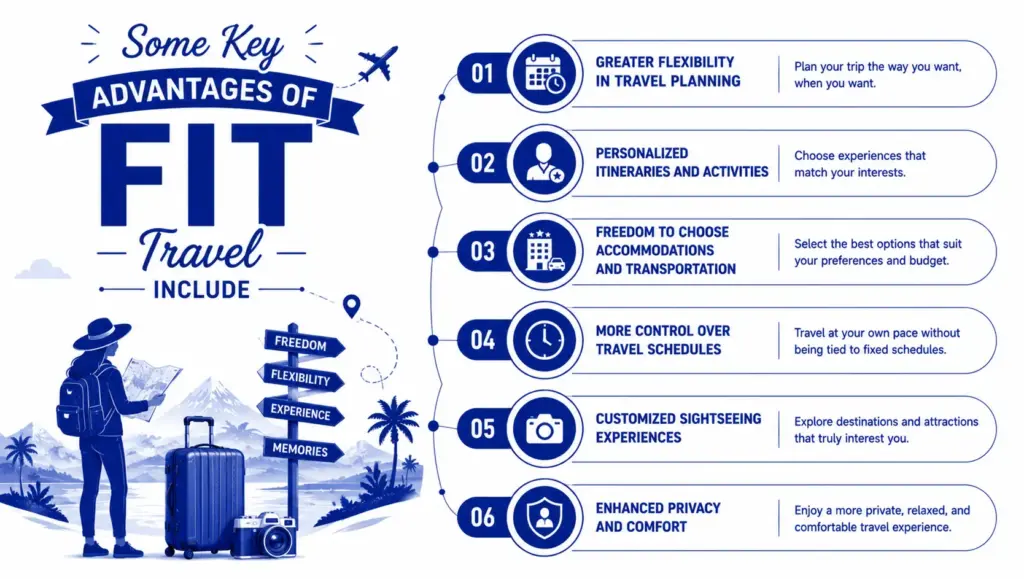
- Greater flexibility in travel planning
- Personalized itineraries and activities
- Freedom to choose accommodations and transportation
- More control over travel schedules
- Customized sightseeing experiences
- Enhanced privacy and comfort
One of the biggest benefits of FIT travel is the ability to create unique experiences. Travelers can spend more time at destinations they enjoy, modify plans when necessary, and explore locations at their own pace. This flexibility is particularly attractive to solo travelers, couples, families, and business travelers seeking personalized travel arrangements.
FIT packages also provide opportunities for premium and niche travel experiences. Whether travelers are interested in cultural tourism, adventure activities, luxury vacations, or specialized itineraries, tour operators can tailor packages to meet specific requirements.
| FIT Benefit | Traveler Advantage |
| Personalized itinerary | Customized experience |
| Flexible schedule | Greater freedom |
| Destination choice | Tailored travel plans |
| Travel pace control | Comfortable journey |
| Individual attention | Enhanced service experience |
Because of these advantages, FIT travel continues to be a preferred option for travelers who value independence and customized experiences within modern tourism markets.
Why GIT Packages Remain Popular in Tourism
Despite the growing demand for personalized travel experiences, GIT packages continue to remain highly popular within the tourism industry. Many travelers prefer organized group tours because they offer convenience, affordability, and professionally managed travel arrangements. For this reason, group inclusive tour packages remain an important segment of FIT and GIT tourism operations worldwide.
Some major advantages of GIT packages include:
- Cost-effective travel options
- Pre-planned itineraries
- Professional tour management
- Group discounts and savings
- Guided sightseeing experiences
- Reduced travel planning responsibilities
One of the primary reasons travelers choose GIT packages is affordability. Since transportation, accommodation, and other travel services are arranged for a group, costs are often shared among participants, making the overall package more economical compared to customized FIT travel.
GIT tours are also convenient because travelers do not need to manage individual bookings, schedules, or logistical arrangements. Tour operators coordinate all major aspects of the journey, allowing travelers to focus on enjoying the experience. This makes GIT particularly attractive for student groups, corporate teams, pilgrimage travelers, and senior citizens.
The popularity of group travel has also contributed to the growth of specialized tourism segments such as educational tours, corporate events, incentive travel, and large-scale group excursions. Understanding how these packages are managed is an important part of learning about group travel operations and the broader travel management industry.
Because of their affordability, convenience, and structured approach, GIT packages continue to play a significant role in modern tourism and remain a preferred choice for many travelers around the world.
How Tour Operators Manage FIT and GIT Bookings
Managing FIT and GIT bookings requires different planning approaches because both travel models have unique customer requirements and operational processes. Tour operators play a crucial role in coordinating transportation, accommodations, sightseeing activities, and customer support to ensure smooth travel experiences. Understanding these operational differences helps students gain a better understanding of FIT and GIT tourism and travel package management.
For FIT bookings, tour operators typically focus on:
- Customizing itineraries according to customer preferences
- Arranging personalized transportation and accommodation
- Coordinating individual sightseeing activities
- Providing flexible travel options
- Managing special customer requests
Since FIT travelers seek personalized experiences, tour operators must pay close attention to individual requirements and provide tailored solutions throughout the travel journey.
For GIT bookings, operators generally focus on:
- Coordinating group travel arrangements
- Managing hotel and transportation block bookings
- Organizing guided tours and activities
- Scheduling group itineraries
- Providing tour escort and support services
GIT operations often involve managing larger numbers of travelers, requiring strong coordination between hotels, transport providers, local guides, and tourism service partners. Efficient planning helps ensure that group travel experiences run smoothly and remain cost-effective.
Understanding how these processes work is an important part of tourism education because it provides practical insights into travel operations and package management. Participating in programs that offer tourism industry exposure can help students gain a deeper understanding of how travel companies manage FIT and GIT bookings while preparing them for careers in tourism operations and travel management.
Why Tourism Students Should Understand FIT and GIT Concepts
Understanding FIT vs GIT in Tourism is important for students because these concepts are widely used throughout the travel and tourism industry. Travel agencies, tour operators, destination management companies, and hospitality organizations regularly work with both individual and group travel segments. Having a clear understanding of these travel models helps students build strong industry knowledge and improve their readiness for professional opportunities.
Knowledge of FIT and GIT concepts helps students:
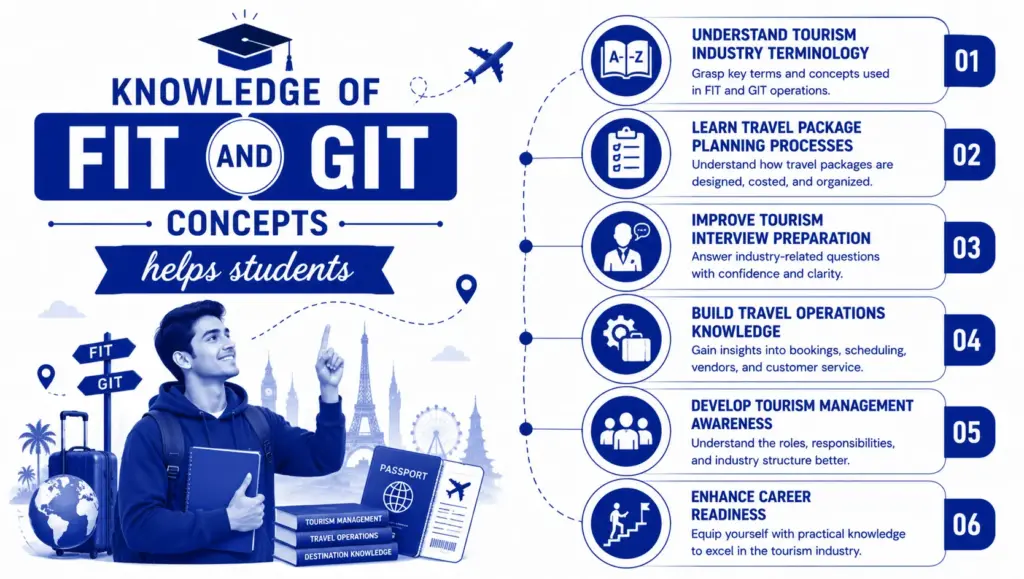
- Understand tourism industry terminology
- Learn travel package planning processes
- Improve tourism interview preparation
- Build travel operations knowledge
- Develop tourism management awareness
- Enhance career readiness
Many tourism job interviews and internships include questions related to travel package types and tourism operations. Students who understand the differences between free independent traveler and group inclusive tour models can demonstrate stronger industry awareness and practical knowledge during recruitment processes.
FIT and GIT concepts also help learners understand how customer preferences influence travel planning and service delivery. By studying these travel models, students gain valuable insights into package customization, customer service expectations, operational coordination, and tourism business strategies.
Developing a strong tourism learning foundation helps students understand industry terminology, travel operations, and tourism management concepts that are essential for building successful careers in the travel and tourism sector.
Final Thoughts
Understanding FIT vs GIT in Tourism is essential for students and aspiring tourism professionals because these concepts form the foundation of travel package planning and tourism operations. FIT and GIT represent two distinct approaches to travel management, each designed to meet different customer preferences, budgets, and travel requirements. While FIT focuses on flexibility and personalized experiences, GIT emphasizes convenience, affordability, and organized group travel.
Knowledge of FIT and GIT tourism helps learners understand how travel agencies and tour operators design and manage different types of tourism packages. It also provides valuable insights into customer behavior, travel planning processes, and operational coordination within the tourism industry. These concepts are frequently used in tourism education, internships, and professional environments, making them important topics for career preparation.
As the travel industry continues evolving, tourism professionals must understand both individual and group travel models to effectively serve diverse customer needs. Building a strong understanding of free independent traveler and group inclusive tour concepts can improve industry awareness, strengthen tourism knowledge, and support long-term career development in travel and tourism management.
Expand Your Knowledge of Tourism Operations
A strong understanding of tourism concepts such as FIT and GIT can help students build industry confidence and prepare for future opportunities in travel management, tour operations, and tourism services. Learning how different travel models function provides valuable insights into real-world tourism practices and customer expectations.
If you want to deepen your understanding of tourism operations and group travel management, explore group travel management and discover how practical industry knowledge can support your tourism career journey.
FAQs
1. What is FIT in tourism?
FIT stands for Free Independent Traveler, referring to individuals or small groups who travel independently with customized itineraries and flexible travel plans.
2. What is GIT in tourism?
GIT stands for Group Inclusive Tour, where travelers participate in a pre-planned group package that typically includes transportation, accommodation, sightseeing, and other travel services.
3. What is the difference between FIT and GIT in tourism?
The main difference is that FIT offers personalized and flexible travel experiences, while GIT provides organized group travel with fixed itineraries and shared services.
4. Which is better: FIT or GIT?
Neither is universally better. FIT is ideal for travelers seeking flexibility and customization, while GIT is suitable for those who prefer affordability, convenience, and organized travel arrangements.
5. Why is FIT travel usually more expensive than GIT travel?
FIT packages are often more expensive because they involve customized services, private arrangements, and personalized travel planning rather than shared group costs.
6. Who typically chooses FIT travel packages?
Solo travelers, couples, families, business travelers, and luxury travelers often prefer FIT packages because they offer greater control and flexibility.
7. Who usually prefers GIT packages?
Student groups, corporate teams, senior citizens, pilgrimage groups, and leisure travelers often choose GIT packages due to their cost-effectiveness and convenience.
8. What services are generally included in a GIT package?
A GIT package may include accommodation, transportation, sightseeing, meals, tour guides, and other travel-related services within a single package.
9. How do travel agencies manage FIT bookings?
Travel agencies customize itineraries, arrange accommodations, coordinate transportation, manage sightseeing activities, and provide personalized travel support based on customer preferences.
10. Why is understanding FIT and GIT important for tourism students?
FIT and GIT are fundamental tourism concepts that help students understand travel operations, package planning, customer preferences, and tourism industry terminology.
11. Are FIT and GIT concepts important in tourism job interviews?
Yes, recruiters often ask tourism students about basic industry concepts such as FIT and GIT to assess their understanding of tourism operations and travel management.
12. Can travel agencies offer both FIT and GIT packages?
Yes, most travel agencies and tour operators provide both FIT and GIT packages to serve different customer segments and travel preferences.
13. What are the advantages of GIT travel?
GIT travel offers lower costs, organized itineraries, professional tour management, group discounts, and reduced planning responsibilities for travelers.
14. What are the advantages of FIT travel?
FIT travel offers personalized itineraries, greater flexibility, destination customization, travel independence, and a more tailored travel experience.
15. How does knowledge of FIT and GIT help build a tourism career?
Understanding FIT and GIT helps students develop tourism industry knowledge, improve career readiness, strengthen interview performance, and gain a better understanding of travel package management and tourism operations.