

Preparing for the IELTS exam can be challenging, especially for students taking the test for the first time. While many candidates focus on improving their English skills, they often overlook the small mistakes that can have a significant impact on their overall performance. In many cases, these errors-not a lack of knowledge-prevent students from achieving their target IELTS band score.
From studying without a clear plan to misunderstanding exam requirements, several common IELTS mistakes can affect performance across the Listening, Reading, Writing, and Speaking modules. Even well-prepared candidates can lose valuable marks when they fail to manage their time effectively, ignore assessment criteria, or neglect their weaker areas.
The good news is that most of these mistakes can be avoided with the right preparation strategy. In this guide, we’ll explore the most common IELTS mistakes students make, understand how they affect exam performance, and discuss practical solutions to help you improve your IELTS preparation and approach the exam with greater confidence.
Why Understanding IELTS Mistakes Is Important
Many students believe that achieving a high IELTS band score depends only on their English proficiency. While language skills play an important role, even well-prepared candidates can lose marks because of avoidable errors. Understanding these mistakes early can help you prepare more effectively and improve your overall performance.
Common IELTS mistakes often occur when students misunderstand exam requirements, manage their time poorly, or fail to follow the assessment criteria. These issues can affect all four modules and prevent candidates from reaching their target score despite having good English skills.
Recognizing and correcting mistakes before the exam offers several benefits:
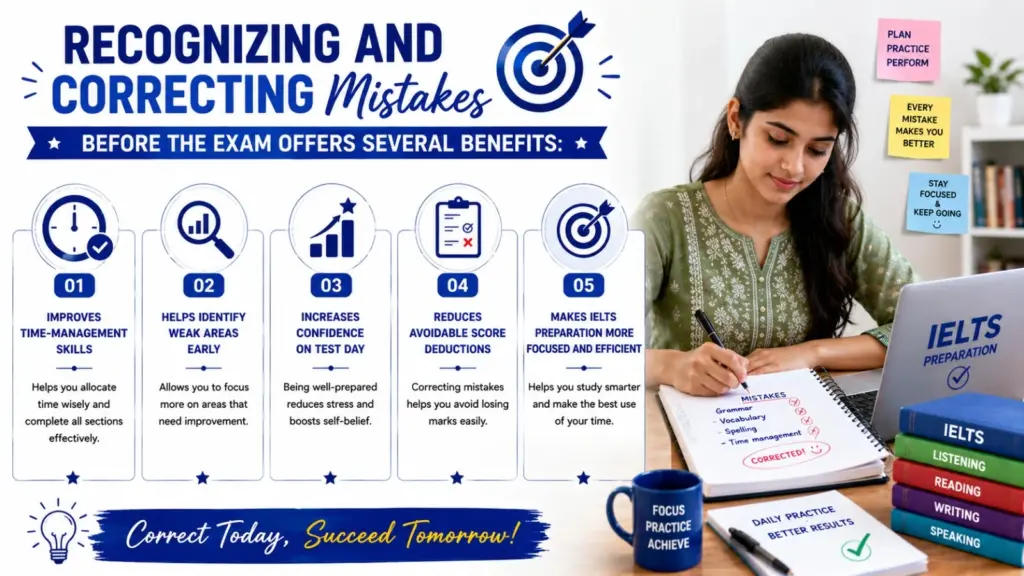
- Improves time-management skills
- Helps identify weak areas early
- Increases confidence on test day
- Reduces avoidable score deductions
- Makes IELTS preparation more focused and efficient
The earlier you identify potential mistakes, the easier it becomes to develop effective preparation strategies. By understanding what commonly goes wrong and how to avoid it, you can approach the IELTS exam with greater confidence and improve your chances of achieving your desired IELTS band score.
Starting IELTS Preparation Without a Clear Study Plan
One of the most common IELTS preparation mistakes is beginning the preparation process without a structured study plan. Many students spend hours practicing different sections randomly, hoping to improve their scores. However, without clear goals and a consistent schedule, it becomes difficult to track progress and identify areas that need improvement.
A study plan helps you allocate time effectively across all four IELTS modules while ensuring balanced preparation. It also prevents last-minute cramming, which often leads to stress and reduced performance on exam day.
Study Plan Mistakes vs Better Preparation Strategies
| Common Mistake | Better Approach |
| Random practice sessions | Follow a structured study plan |
| Ignoring weak areas | Balance all four modules |
| Last-minute preparation | Study consistently every week |
| No performance tracking | Review progress regularly |
To create an effective IELTS preparation plan:
- Set a realistic target band score.
- Divide study time across Listening, Reading, Writing, and Speaking.
- Take regular mock tests.
- Review mistakes after every practice session.
- Adjust your study plan based on progress.
According to common mistakes when preparing for IELTS, many candidates underestimate the importance of planning and often focus on studying harder rather than studying smarter. A clear study schedule helps students stay organized, improve consistently, and prepare more effectively for the exam.
By following a structured approach instead of studying randomly, you can make better use of your preparation time and increase your chances of achieving your desired IELTS band score.
Ignoring the IELTS Exam Format and Assessment Criteria
Many students focus heavily on improving their English skills but overlook the importance of understanding how the IELTS exam is structured. This is one of the most common IELTS preparation mistakes, as even strong English speakers can lose marks if they are unfamiliar with the test format and assessment criteria.
Each IELTS module has specific requirements that examiners use to evaluate performance. For example, the Writing section is assessed based on task achievement, coherence, vocabulary, and grammar, while the Speaking test focuses on fluency, pronunciation, lexical resource, and grammatical accuracy. Without understanding these criteria, candidates may not know where they are losing marks.
Some areas students should familiarize themselves with include:
- Listening question types and instructions
- Reading passage formats and time limits
- Writing task requirements and scoring criteria
- Speaking test structure and evaluation standards
Common mistakes include:
- Misinterpreting instructions
- Writing fewer words than required
- Spending too much time on difficult questions
- Providing incomplete responses
- Ignoring assessment criteria
Understanding what examiners expect allows students to prepare more strategically and focus on areas that directly impact their IELTS band score. It also helps reduce anxiety on exam day because candidates know what to expect in each section.
By taking the time to learn the exam format and scoring system, students can avoid unnecessary mistakes and approach the IELTS exam with greater confidence and clarity.
Common Mistakes in Each IELTS Module
Every section of the IELTS exam presents unique challenges, and many students lose marks because they repeat the same mistakes during preparation and on test day. Understanding these errors can help candidates improve their performance and achieve a better IELTS band score.
Mistakes That Can Reduce Your IELTS Band Score
Listening
Many candidates lose marks because they lose concentration during the audio recording or fail to identify important keywords.
How to avoid it:
- Practice active listening daily.
- Focus on keywords and signal words.
- Read questions before the recording begins.
Reading
A common mistake is spending too much time reading every word instead of locating relevant information efficiently.
How to avoid it:
- Use skimming and scanning techniques.
- Practice managing time across all passages.
- Learn to identify keywords quickly.
Writing
Students often lose marks by writing off-topic responses or failing to organize their ideas properly.
How to avoid it:
- Understand the task requirements carefully.
- Use a clear introduction, body, and conclusion.
- Allocate time for proofreading.
Speaking
Many candidates memorize answers, which can make responses sound unnatural and affect fluency scores.
How to avoid it:
- Practice speaking naturally.
- Expand answers with examples.
- Focus on communication rather than memorization.
Module-Wise Mistakes and Solutions
| Module | Common Mistake | Solution |
| Listening | Missing key details | Practice active listening |
| Reading | Poor time management | Use skimming and scanning |
| Writing | Weak structure | Follow a clear format |
| Speaking | Memorized answers | Communicate naturally |
By identifying these module-specific mistakes early, students can focus on targeted improvements and approach each section of the IELTS exam with greater confidence.
Overlooking Practice Tests and Performance Analysis
Many students spend a significant amount of time studying concepts but fail to evaluate their progress through regular practice tests. This is one of the most common IELTS preparation mistakes because mock tests help candidates understand their strengths, weaknesses, and readiness for the actual exam.
Practice tests simulate real exam conditions and help students become familiar with question formats, time limits, and performance expectations. More importantly, they reveal recurring mistakes that may otherwise go unnoticed during regular study sessions.
Benefits of taking practice tests include:

- Improving time-management skills
- Identifying weak areas early
- Building exam-day confidence
- Understanding question patterns
- Tracking performance over time
However, taking practice tests alone is not enough. Students should also analyze their results carefully and focus on areas where they consistently lose marks. Reviewing mistakes can provide valuable insights into what needs improvement before the actual exam.
Candidates can learn more about common mistakes to avoid in the IELTS exam and understand how proper practice and performance analysis can contribute to better exam results.
By combining regular mock tests with detailed performance reviews, students can make their preparation more effective and improve their chances of achieving their target IELTS band score.
Focusing Only on Strong Areas and Neglecting Weak Skills
Many IELTS candidates naturally spend more time practicing sections they are already comfortable with. While this may boost confidence, it can create an imbalance in preparation and negatively affect the overall IELTS band score. Since IELTS evaluates performance across four modules, weaknesses in one area can significantly impact the final result.
For example, a student who performs well in Reading and Listening may avoid practicing Writing because it feels more challenging. However, ignoring weaker sections often leads to lower scores and missed opportunities to improve overall performance.
To build a balanced preparation strategy:
- Identify your weakest module through mock tests.
- Set specific improvement goals for each section.
- Allocate extra study time to weaker areas.
- Track progress regularly.
- Seek feedback on challenging tasks.
A balanced approach helps candidates develop confidence across all four modules while reducing the risk of unexpected score drops. Consistent improvement in weaker areas often contributes more to overall score growth than repeatedly practicing stronger sections.
Students looking for additional IELTS exam tips for better performance can learn practical strategies for identifying weaknesses and improving preparation efficiency.
Rather than focusing only on your strengths, dedicate time to improving areas that need attention. This approach can help create a more well-rounded preparation strategy and increase your chances of achieving your target IELTS band score.
How Structured Guidance Helps Students Avoid IELTS Preparation Mistakes
While self-study can be effective, many students struggle to identify their weaknesses and correct recurring mistakes without proper guidance. As a result, they may continue using ineffective study methods that limit their progress and affect their IELTS band score.
Structured guidance helps students prepare more strategically by providing a clear learning path, expert feedback, and regular performance evaluations. Instead of guessing what to study next, candidates can focus on the areas that require the most improvement.
Some benefits of guided IELTS preparation include:
- Personalized feedback on Writing and Speaking tasks
- Regular mock tests and progress tracking
- Better understanding of assessment criteria
- Improved time-management strategies
- Consistent study schedules and accountability
Professional guidance can also help students avoid common IELTS preparation mistakes such as neglecting weaker modules, misunderstanding task requirements, and practicing without a clear objective.
Students interested in learning more about Wilfred’s Academy can explore how structured training programs support learners in achieving their academic and career goals.
In addition, an industry-academia learning approach helps students develop practical communication skills alongside exam preparation, creating a stronger foundation for future educational and professional opportunities.
With the right guidance and a well-planned preparation strategy, students can avoid common mistakes, improve their confidence, and approach the IELTS exam with greater clarity and focus.
Final Thoughts
Many students lose valuable marks in IELTS not because of a lack of ability, but because of avoidable mistakes during their preparation. From studying without a plan to neglecting weaker modules and overlooking practice tests, these errors can significantly impact overall performance and prevent candidates from achieving their target IELTS band score.
The good news is that most IELTS preparation mistakes can be corrected with the right approach. Understanding the exam format, following a structured study plan, practicing consistently, and reviewing your performance regularly can help you avoid common pitfalls and prepare more effectively.
By identifying these common IELTS mistakes and applying the strategies discussed in this guide, you can build confidence, improve your skills across all four modules, and increase your chances of achieving success in the IELTS exam.
Start Your IELTS Preparation the Right Way
Achieving a high IELTS score requires more than hard work-it requires the right strategy, expert guidance, and consistent practice. Whether you are preparing for higher education, career opportunities, or migration goals, a structured preparation plan can help you avoid common mistakes and make steady progress toward your target score.
If you’re ready to prepare with confidence, explore our IELTS preparation program and discover how expert support, practical training, and personalized guidance can help you achieve your IELTS goals.
FAQs
1. What are the most common IELTS mistakes students make?
Some of the most common IELTS mistakes include studying without a plan, ignoring weaker modules, misunderstanding exam requirements, poor time management, and skipping mock tests. These mistakes can reduce overall performance and affect your IELTS band score.
2. How can I avoid mistakes during IELTS preparation?
You can avoid IELTS preparation mistakes by creating a structured study plan, understanding the exam format, practicing consistently, reviewing your mistakes, and taking regular mock tests to track your progress.
3. Why is understanding the IELTS format important?
Understanding the IELTS format helps you become familiar with question types, time limits, and assessment criteria. This reduces confusion on exam day and allows you to prepare more effectively for each module.
4. Can mock tests improve IELTS scores?
Yes, mock tests help improve IELTS scores by simulating real exam conditions, identifying weak areas, improving time management, and building confidence before the actual test.
5. What mistakes lower IELTS Writing scores?
Common Writing mistakes include going off-topic, poor paragraph organization, grammar errors, limited vocabulary, and failing to meet the word count requirement. Understanding the assessment criteria can help avoid these issues.
6. How can I improve my IELTS Speaking performance?
Regular speaking practice, expanding answers with examples, improving pronunciation, and avoiding memorized responses can help improve fluency and confidence in the IELTS Speaking test.
7. Is a study plan necessary for IELTS preparation?
Yes, a study plan helps organize your preparation, allocate time effectively across all modules, track progress, and ensure consistent improvement throughout your IELTS preparation journey.
8. What is the biggest mistake beginners make in IELTS?
One of the biggest mistakes beginners make is focusing only on English improvement while ignoring exam strategies, assessment criteria, and time-management techniques that are essential for achieving a higher score.
9. How often should I take IELTS practice tests?
Most candidates benefit from taking a full-length practice test every one or two weeks. As the exam date approaches, increasing the frequency of mock tests can help improve readiness and confidence.
10. Can coaching help me avoid IELTS preparation mistakes?
Yes, coaching can help identify weaknesses, provide personalized feedback, improve exam strategies, and guide students toward more effective preparation methods, reducing the chances of making common IELTS mistakes.